
The word ‘crucial’ (from the Latin, crux
or cross) was first used by Francis Bacon in the 1620s, and later by Robert Boyle and Isaac Newton, to denote the point (cross road) in an experiment when it becomes clear which of two hypotheses is correct — experimentum crucis
(‘crucial experiment’). When an English equivalent was later created it acquired the sense of something that is important or highly significant, perhaps vital to the determination of a particular outcome or the resolution of a crisis.
I hope, through this website, to encourage the exchange of crucial information on the important question of improving public access to accurate, useful and timely information on important social and environmental issues. I also want to challenge and expose pseudo-science, fake news and religious bigotry, especially where these impostors threaten to dupe or confuse the public, or where their protagonists pose a threat to social cohesion, democracy or the rule of law.
I hope, through this website, to encourage the exchange of crucial information on the important question of improving public access to accurate, useful and timely information on important social and environmental issues. I also want to challenge and expose pseudo-science, fake news and religious bigotry, especially where these impostors threaten to dupe or confuse the public, or where their protagonists pose a threat to social cohesion, democracy or the rule of law.

There are for me few things more important in this ‘post-truth’ era than having an informed and concerned citizenry, not least when it comes to the existential threats that now confront us from resource depletion, biosphere degradation / species loss and climate change, and on the political front, religious fundamentalists, who seek to impose their particular brand of insanity on society.
In this mad world of Trump, Putin and Farage, facts and opinions have become seemly inter-changeable, evidence and reasoned analysis is dismissed, and experts are routinely reviled and ridiculed. This toxic combination of factors is causing confusion, distress and political instability in so many countries. Indeed humankind now faces the very real possibility that increased tensions could, either by design or accident, lead to open conflict between the super powers, perhaps even the deployment of nuclear weapons.
LINKS TO RELATED ARTICLES
Recent papers on post-truth politics, and information manipulation & dissemination:'What's True Anymore?' [2017] (Post-truth)
Papers on Humanism:
'What it means to be a Humanist' [2016]
'Humanism: an 'insane form of thinking'' [2016]
Seeking Common Ground
I would also like to encourage people to ease up on attacking others’ beliefs. How much more productive to look for areas of agreement and common purpose? Most people are fundamentally law-abiding, but not everybody has the education, training or temperament to be able to cope with the deluge of information and opinion that now invades our personal space. And whilst it may be possible, by engaging people in debate or setting an example, to change their understanding or views, the same does not apply to people's religious beliefs, especially when those beliefs were instilled into them in childhood.[1] Indeed, research shows that beliefs can become even more entrenched if challenged or ridiculed. All social groups, regardless of culture, tradition or religious faith can bring something to the table that is worthy of respect and something that can be built on. So in today’s divided world is it not eminently sensible for us to be seeking out allies and looking for areas of common ground rather than lampooning people's beliefs and sowing the seeds of division?
I would also like to encourage people to ease up on attacking others’ beliefs. How much more productive to look for areas of agreement and common purpose? Most people are fundamentally law-abiding, but not everybody has the education, training or temperament to be able to cope with the deluge of information and opinion that now invades our personal space. And whilst it may be possible, by engaging people in debate or setting an example, to change their understanding or views, the same does not apply to people's religious beliefs, especially when those beliefs were instilled into them in childhood.[1] Indeed, research shows that beliefs can become even more entrenched if challenged or ridiculed. All social groups, regardless of culture, tradition or religious faith can bring something to the table that is worthy of respect and something that can be built on. So in today’s divided world is it not eminently sensible for us to be seeking out allies and looking for areas of common ground rather than lampooning people's beliefs and sowing the seeds of division?
We may think we know what changes we would like to see in the world, but it takes more than logic to get one's message across. This idea is wonderful expressed in the adjacent New Yorker
cartoon by the late, great Charles Barsotti. Those of us who care about the quality of public dialogue and understanding are going to have to become a lot shrewder and more persistent if we are to have any discernible impact on others' thinking, attitude and behaviour, and change the world for the better.
I hope you find this website thought-provoking and informative, and if you have comments or suggestions, please get in touch so that we can share your thoughts and ideas with others.
I hope you find this website thought-provoking and informative, and if you have comments or suggestions, please get in touch so that we can share your thoughts and ideas with others.
Please Note: This Website is new and still under construction. Please be patient. Thank you.
Sections Below:
# The Good, the Bad & the Unspeakably Ugly
# Links to Papers
# Post-Truth Glossary
# Notes
# Link to About
Sections Below:
# The Good, the Bad & the Unspeakably Ugly
# Links to Papers
# Post-Truth Glossary
# Notes
# Link to About

The Good, the Bad & the Unspeakably Ugly
We are all accustomed to the selective use of information to promote a particular person, product or belief — not least by the tabloid media, which must bear a heavy responsibility for much of the disinformation, rumour and false news that is today swilling around the psychosphere. But with open source blogging sites like WordPress, social networking services like Facebook, and video sharing websites like YouTube, anybody with a computer and a modicum of intelligence can disseminate information, images and opinion. The combination of the internet, social media and mobile phones have enabled information to be shared, reworked, spun, manipulated and disseminated on a truly industrial scale; and where material is sufficiently interesting, saucy or scurrilous it can go viral and within hours reach a global audience of millions. But very little of this phenomenal output is edited or peer reviewed, and much of it is partial, opinionated, or just plain wrong— and we should include here the output from wise-boys and fraudsters who use click-bait[2] to attract punters to their dubious promotions and websites, and the sad or malicious individuals who spread conspiracy theories.
Whether material is unintentionally wrong (misinformation) or wrong by design (disinformation) is irrelevant as it drowns out accurate and considered copy; and most of us struggle to tell fact from fiction. Moreover, those whose very job it is to winkle out the truth, professional journalists, are losing their jobs by the thousands as traditional newspapers and news channels go to the wall because people no longer want to pay for content. Indeed, an increasing number of us are relying on social media for much or all of our news.
Another concern is it those ill-informed commentators, often with a hidden agenda, who expect their views to be given equal weight to those of experienced professionals, not least on such critical topics as vaccination, stem-cell research, fracking, genetics and climate change.[3] They too are making good use of the internet. We also have the proverbial snake-oil salesmen and alternative therapy enthusiasts who promote quack remedies and pseudoscience, like homeopathy or gem therapy; and the people who think that ‘intelligent design’ or their particular religious beliefs should be taught to young children as 'true'.[4] This is not acceptable in the modern world. It represents the worst form of uncritical thinking, and has serious potential consequences for social cohesion.
So whilst the Internet has become an extraordinary tool for research, education, commerce, entertainment and social intercourse, it is being used increasingly to disseminate gossip and uninformed opinion, and worse, negative advertising, false news, conspiracy theories, hate mail, revenge porn and extremist propaganda (and there's reputedly much worse on the Dark Web); and on top of this there are the likes of President Putin orchestrating much of this chaos and no doubt reveling in the political, economic and social chaos that is being visited on their enemies and rivals.
We are all accustomed to the selective use of information to promote a particular person, product or belief — not least by the tabloid media, which must bear a heavy responsibility for much of the disinformation, rumour and false news that is today swilling around the psychosphere. But with open source blogging sites like WordPress, social networking services like Facebook, and video sharing websites like YouTube, anybody with a computer and a modicum of intelligence can disseminate information, images and opinion. The combination of the internet, social media and mobile phones have enabled information to be shared, reworked, spun, manipulated and disseminated on a truly industrial scale; and where material is sufficiently interesting, saucy or scurrilous it can go viral and within hours reach a global audience of millions. But very little of this phenomenal output is edited or peer reviewed, and much of it is partial, opinionated, or just plain wrong— and we should include here the output from wise-boys and fraudsters who use click-bait[2] to attract punters to their dubious promotions and websites, and the sad or malicious individuals who spread conspiracy theories.
Whether material is unintentionally wrong (misinformation) or wrong by design (disinformation) is irrelevant as it drowns out accurate and considered copy; and most of us struggle to tell fact from fiction. Moreover, those whose very job it is to winkle out the truth, professional journalists, are losing their jobs by the thousands as traditional newspapers and news channels go to the wall because people no longer want to pay for content. Indeed, an increasing number of us are relying on social media for much or all of our news.
Another concern is it those ill-informed commentators, often with a hidden agenda, who expect their views to be given equal weight to those of experienced professionals, not least on such critical topics as vaccination, stem-cell research, fracking, genetics and climate change.[3] They too are making good use of the internet. We also have the proverbial snake-oil salesmen and alternative therapy enthusiasts who promote quack remedies and pseudoscience, like homeopathy or gem therapy; and the people who think that ‘intelligent design’ or their particular religious beliefs should be taught to young children as 'true'.[4] This is not acceptable in the modern world. It represents the worst form of uncritical thinking, and has serious potential consequences for social cohesion.
So whilst the Internet has become an extraordinary tool for research, education, commerce, entertainment and social intercourse, it is being used increasingly to disseminate gossip and uninformed opinion, and worse, negative advertising, false news, conspiracy theories, hate mail, revenge porn and extremist propaganda (and there's reputedly much worse on the Dark Web); and on top of this there are the likes of President Putin orchestrating much of this chaos and no doubt reveling in the political, economic and social chaos that is being visited on their enemies and rivals.
Reason, Empathy & Kindness
It makes sense to be sceptical when confronted with new information, especially when it comes from an unknown source or might have far-reaching implications, and this requires critical thinking, a clear head and an open-mind — although not too open a mind that there’s a danger of your brains falling out. Critical thinking requires keeping your feelings and emotions under control, and listening to alternative points of view before drawing conclusions and taking action; and it requires being sensitive to possible prejudice or bias, including one’s own.[5] In respect of this last point I should declare an interest: as a humanist I would like to see more reason, empathy and kindness in the world, and you will find this reflected in my writings and talks.
It makes sense to be sceptical when confronted with new information, especially when it comes from an unknown source or might have far-reaching implications, and this requires critical thinking, a clear head and an open-mind — although not too open a mind that there’s a danger of your brains falling out. Critical thinking requires keeping your feelings and emotions under control, and listening to alternative points of view before drawing conclusions and taking action; and it requires being sensitive to possible prejudice or bias, including one’s own.[5] In respect of this last point I should declare an interest: as a humanist I would like to see more reason, empathy and kindness in the world, and you will find this reflected in my writings and talks.
Critical thinkers have a passion for ‘the truth’ — “the best mind-altering drug”[6] — although anyone who has studied the subject recognises that ‘truth’ is a particularly slippery concept. For me trying to work out what is true and what is not true is a fascinating and absorbing challenge.[7] Oscar Wilde once said that the truth is ‘rarely pure and never simple’; and André Gide called it ‘grey’ and advised us to ‘believe those who seek it’ and ‘doubt those who find it’.
PAPERS
Here are some of my most recent papers on the way information is formulated, manipulated and disseminated, and the impact that this can have on society:
- 'Bad Information' [Milton Keynes Humanists, 2015]
- 'What's True Anymore?' Life in the Post-Truth Era [Milton Keynes Humanists, 2017]
- 'What it means to be a Humanist'
[Milton Keynes Humanists, 2016]
- 'Humanism: an 'insane form of thinking''
[Milton Keynes Humanists, 2015]
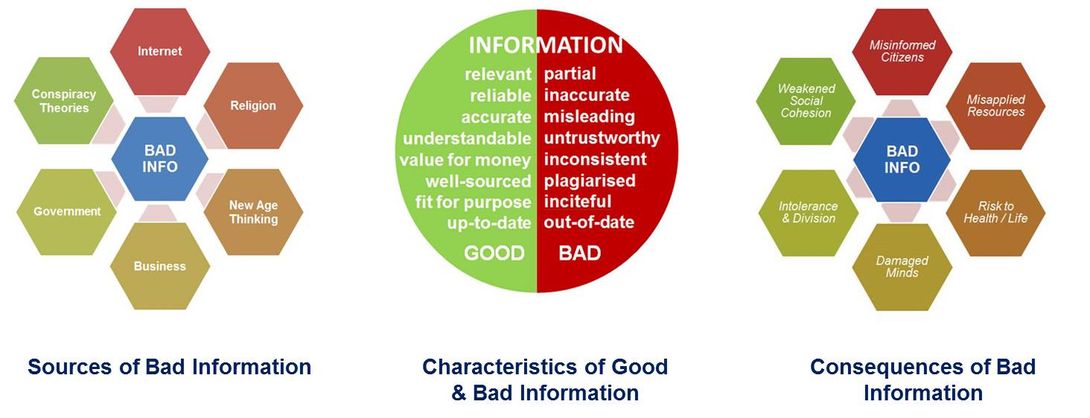
Graphics from 'Bad Information'

POST-TRUTH GLOSSARY
Here are words, old and new, that we are likely to be seeing more in the media:
- Alternative Fact —
something you prefer to consider as 'true' (in contrast to a real 'fact', a piece of information presented as having objective reality)
- Backfire Effect — finding that, given evidence against their beliefs, people can reject the evidence and believe even more strongly / when your deepest convictions are challenged by contradictory evidence, your beliefs get stronger.
- Botnet — a network of private computers infected with malicious software and controlled as a group without the owners' knowledge, e.g. to send spam.
- Clickbait — a pejorative term used to describe web content that is aimed at generating online advertising revenue, especially at the expense of quality or accuracy. It relies on sensationalist headlines or eye-catching thumbnail pictures to attract click-throughs and encourage forwarding of the material over online social networks. Clickbait headlines typically aim to exploit the 'curiosity gap', providing just enough information to make readers curious, but not enough to satisfy their curiosity without clicking through to the linked content.
- Conspiracy theory — a belief that some covert but influential organization is responsible for an unexplained event.
- Cyberbullying — the use of cell phones, instant messaging, e-mail, chat rooms or social networking sites to harass, threaten or intimidate someone (often carried out by children).
- Dark Web — collection of thousands of websites that use anonymity tools like Tor and I2P to hide their IP address.
- Denialism — a person's choice to deny reality, as a way to avoid a psychologically uncomfortable truth.
- Digital Wildfire — false or sensitive information that is spread rapidly over the internet.
- Disinformation — false information which is intended to mislead, especially propaganda released by a government organization to a rival power or the media.
- Echo Chamber — a situation in which information, ideas or beliefs are amplified or reinforced by communication and repetition inside a defined system.
- Eye Candy — visual images that are superficially attractive and entertaining but intellectually undemanding.
- Factoid — an item of unreliable information that is reported and repeated so often that it becomes accepted as fact.
- Fideist — person who sees faith as independent of reason and considers it superior in arriving at particular truths.
- Filter Bubble — results of a personalized search in which a website algorithm selectively guesses what information a user would like to see based on information about the user (location, past click behaviour, search history, etc.).
- Mind game — a course of psychologically manipulative behaviour intended to discomfit another person or gain an advantage over them.
- Misinformation — false or incorrect information, spread intentionally or unintentionally without realizing it is untrue.
- Pseudoscience — a collection of beliefs or practices mistakenly regarded as being based on scientific method.
- Psychosphere — the sphere or realm of human consciousness (originally, now rare, the part of the biosphere inhabited by humans).
- Sociopath — a person with a personality disorder manifesting itself in extreme antisocial attitudes and behaviour.
- Sock Puppet Software — software that creates fake online identities to enable propaganda to be spread anonymously eg to counter extremist groups or unsettle or damage governments.
- Troll — a person who starts arguments or deliberately upsets people by posting inflammatory or extraneous messages in an online community (newsgroup, chat room, blog etc.) to provoke an emotional response from readers or disrupt normal on-topic discussion.
- Truthiness — the quality of seeming to be true according to one's intuition, opinion or perception without regard to logic, factual evidence or the like.
- Post-Truth — applied to politics this denotes circumstances in which objective facts are less influential in shaping public opinion than simplistic argument and appeals to raw emotion and personal belief. (Declared ‘2016 Word of the Year’ by Oxford Dictionaries.)
- Useful Idiots — a term born of the Cold War which describes people or institutions that unknowingly assisted Soviet Union propaganda efforts.
- Vulgarian — an uncouth, unrefined person, especially one whose vulgarity is the more conspicuous because of wealth, prominence or pretensions to good breeding.
- Wikihacking — manipulating content on Wikipedia in order to manage reputation, promote some interests or other, affect page rank/link traffic, or simply to cause harm.
Notes
1 I'm not suggesting here that people should not challenge bigotry and intolerance, quite the reverse. As Karl Popper said, we must be intolerant of the intolerant: “If we are not prepared to defend a tolerant society against the onslaught of the intolerant, then the tolerant will be destroyed, and tolerance with them." And this includes the religious fundamentalists who want everyone else to kow-tow to their particular beliefs or world view. A less well-known quote by Popper is: "Those who promise us paradise on earth never produced anything but a hell."
2 'Clickbait' is a pejorative term used to describe web content that is aimed at generating online advertising revenue, especially at the expense of quality or accuracy. For more about this and other new or resurrected words or expressions see the Glossary. There has been a backlash against clickbait, which started around 2014 when the satirical digital organ The Onion launched a new website, ClickHole, that parodied clickbait websites such as BuzzFeed. Facebook has also announced that it is taking technical measures to reduce the impact of clickbait on its social network.
3 I’m not suggesting that people should not be critical of new technologies or techniques, like genetic manipulation, whether to eradicate congenital diseases or improve crop yields/introduce better disease-resistance; rather I am arguing that any criticism should be constructive and have some basis in fact.
4 I think children should be taught about religion. It is a major influence in world politics. But to teach children (or gullible adults) that your belief is the only true religion is a recipe for social division and, in all too many parts of the world, terror, bloodshed and unresolvable conflict.
5 We need to be especially vigilant as our personal feelings, tastes or opinions as these are shaped by our upbringing and strongly influenced by what we read or see, and the people we associate with (so-called ‘confirmation bias’). This comforting endorsement of our views and beliefs may be reinforced by the ‘echo chamber effect’ (where information, ideas or beliefs are amplified or reinforced by repetition within one’s personal network), and also when we go on line and our search engine (which knows so much about us) helpfully select things that we are likely to want to see. The result of this pre-selection is that we live in our own cultural or ideological bubble, effectively isolated from dissonant ideas and alternative points of view, and this is a recipe for heightening suspicion and misunderstanding, which can lead to social division.
6 This quote is by Lily Tomlin. You will find quotes scattered throughout my writings: I like to use them because they can, like poetry or cartoons, encapsulate a complex idea or throw light on some aspect of the human condition. Quotes also enable us to recognise the contribution that others have made to the debate or to our knowledge and understanding.
7 For what it's worth, you will my thoughts on 'truth' in my paper: 'What's True Anymore?'
1 I'm not suggesting here that people should not challenge bigotry and intolerance, quite the reverse. As Karl Popper said, we must be intolerant of the intolerant: “If we are not prepared to defend a tolerant society against the onslaught of the intolerant, then the tolerant will be destroyed, and tolerance with them." And this includes the religious fundamentalists who want everyone else to kow-tow to their particular beliefs or world view. A less well-known quote by Popper is: "Those who promise us paradise on earth never produced anything but a hell."
2 'Clickbait' is a pejorative term used to describe web content that is aimed at generating online advertising revenue, especially at the expense of quality or accuracy. For more about this and other new or resurrected words or expressions see the Glossary. There has been a backlash against clickbait, which started around 2014 when the satirical digital organ The Onion launched a new website, ClickHole, that parodied clickbait websites such as BuzzFeed. Facebook has also announced that it is taking technical measures to reduce the impact of clickbait on its social network.
3 I’m not suggesting that people should not be critical of new technologies or techniques, like genetic manipulation, whether to eradicate congenital diseases or improve crop yields/introduce better disease-resistance; rather I am arguing that any criticism should be constructive and have some basis in fact.
4 I think children should be taught about religion. It is a major influence in world politics. But to teach children (or gullible adults) that your belief is the only true religion is a recipe for social division and, in all too many parts of the world, terror, bloodshed and unresolvable conflict.
5 We need to be especially vigilant as our personal feelings, tastes or opinions as these are shaped by our upbringing and strongly influenced by what we read or see, and the people we associate with (so-called ‘confirmation bias’). This comforting endorsement of our views and beliefs may be reinforced by the ‘echo chamber effect’ (where information, ideas or beliefs are amplified or reinforced by repetition within one’s personal network), and also when we go on line and our search engine (which knows so much about us) helpfully select things that we are likely to want to see. The result of this pre-selection is that we live in our own cultural or ideological bubble, effectively isolated from dissonant ideas and alternative points of view, and this is a recipe for heightening suspicion and misunderstanding, which can lead to social division.
6 This quote is by Lily Tomlin. You will find quotes scattered throughout my writings: I like to use them because they can, like poetry or cartoons, encapsulate a complex idea or throw light on some aspect of the human condition. Quotes also enable us to recognise the contribution that others have made to the debate or to our knowledge and understanding.
7 For what it's worth, you will my thoughts on 'truth' in my paper: 'What's True Anymore?'
